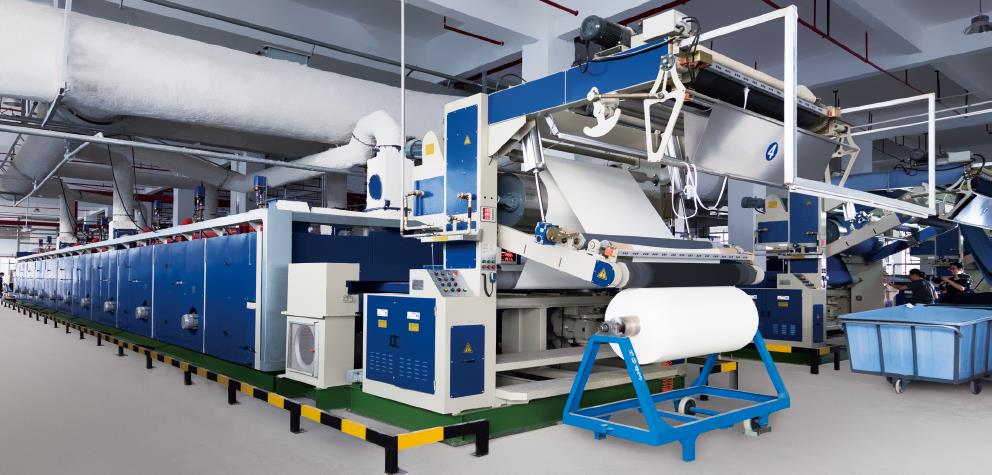
A stenter (also called a stenter frame) is a textile finishing machine used to dry, heat-set, and control the width of fabric after dyeing, washing, or chemical finishing. It holds the fabric edges with clips or pins while transporting it through heated chambers, ensuring the fabric reaches the required width, dimensional stability, and finish.
Main Functions of a Stenter
- Drying wet fabric after dyeing or washing.
- Heat setting synthetic fabrics (e.g., polyester, nylon) to stabilize dimensions.
- Width control by stretching the fabric to the desired width.
- Applying chemical finishes such as softeners, wrinkle-resistant, water-repellent, flame-retardant, or anti-static finishes.
- Improving fabric appearance by reducing wrinkles and ensuring a smooth surface.
Types of Stenter Machines
- Pin Stenter
- Fabric edges are held by pins.
- Suitable for lightweight and knitted fabrics.
- Provides good width control but may leave pin marks.
- Clip Stenter
- Fabric edges are held by clips.
- Ideal for woven and delicate fabrics.
- Prevents pin holes or marks.
- Pin-and-Clip Stenter
- Combines both pins and clips.
- Offers better edge holding and improved dimensional stability.
- Widely used in modern textile processing.
- Horizontal Stenter
- Fabric travels horizontally through heated chambers.
- The most common design in textile finishing plants.
- Vertical Stenter
- Fabric moves vertically through the machine.
- Used where floor space is limited or for specialized applications.
Main Components
- Entry unit
- Padding mangle (optional, for chemical application)
- Pin or clip chain
- Overfeed device
- Heated chambers (gas, steam, or electric)
- Exhaust and air circulation system
- Cooling zone
- Fabric batching or plaiting unit
- PLC/HMI control system
Applications
- Cotton fabrics
- Polyester fabrics
- Cotton/polyester blends
- Knitted fabrics
- Woven fabrics
- Technical textiles
A stenter is one of the most important machines in a textile finishing plant because it ensures the fabric has the correct width, GSM (weight), dimensional stability, and finishing quality before inspection and packing.